The post How long will vaccines protect us from COVID-19? Vancouver researchers get grant to find out. appeared first on Medicine Matters.
]]>BY PAMELA FAYERMAN
Blood samples from residents and staff of long term care (LTC) facilities will provide precious clues into how the immune system reacts to both COVID-19 infections and vaccinations.
Vancouver researchers at Providence Health Care, Simon Fraser University, UBC and the BC Centre for Excellence in HIV/AIDS have been granted over $1 million from the federal government to conduct and analyze blood draws from residents and staff of LTC facilities before and after vaccinations. That will allow experts to learn how to understand more about immunity so they can learn how to protect individuals who live and work in the facilities from future outbreaks. Healthcare workers in acute care facilities will also be included in the blood analysis research.
No one knows for sure yet how long immunity to COVID-19 will endure after vaccinations and/or infections. Will we require shots on an annual basis as is the case for protection from influenza? Perhaps, especially the elderly with less robust immune systems.
Principal investigator Dr. Marc Romney said in an interview that hundreds of blood samples have already been collected – including from individuals who died at Holy Family Hospital during an outbreak last year. Their blood has been banked as will all other samples drawn from study participants who will be asked for at least four specimens over a one-year period, including before vaccination, a month after and then again after their second vaccine doses. (Blood samples from deceased individuals will obviously not be useful for post-vaccination research).
The durability of the immune system response will be evidenced by various components including antibodies, T-cells, B-cells and cytokines.
Dr. Romney, the clinical associate professor at UBC and medical leader for medical microbiology and virology at St. Paul’s Hospital, said the hypothesis is that immunosenescence is a defining factor in immune durability. Immunosenescence is the gradual deterioration of immune systems as individuals age which affects the capacity to respond to infections and to maintain long-term immune memory acquired by infection or vaccination.
“The elderly have fragile white blood cells. They’re relatively immune compromised so it’s important to know how durable their vaccine protection is for them,” he said.
Since everyone will want the results “yesterday,” Romney said researchers will release interim results in stages to help with vaccination planning in 2022 and beyond. Romney has also been active in the development of pre-flight rapid testing protocols at the Vancouver International Airport.
The study will utilize state of the art technology that helps analyze vaccine-induced immunity. The research is part of the federal government’s COVID-19 Immunity Task Force (CITF). Scientists across Canada have been asked to conduct research that helps answer what proportion of the general population has antibodies to COVID-19; how long immunity lasts after infections; what antibody tests are the best; and how long individuals are protected against COVID after being vaccinated.
In Alberta, teams will look at vaccine-induced immunity as well as whether sewage wastewater can be used as an early warning system to detect outbreaks in LTC facilities. Wastewater samples from selected LTC facilities in Edmonton will be analyzed to determine whether the virus is circulating even before residents and staff develop symptoms. If levels of COVID biomarkers are detected, then it would trigger rapid testing to identify those who are infected to help prevent the spread of the disease.
EMAIL: [email protected]
The post How long will vaccines protect us from COVID-19? Vancouver researchers get grant to find out. appeared first on Medicine Matters.
]]>The post As vaccinations resume, health pros cautioned about selfies on social media appeared first on Medicine Matters.
]]>COVID-19 vaccinations are expected to resume again in the next few weeks after a lull due to vaccine scarcity from suppliers. Selfie photos posted on social media of individuals getting vaccinated can trigger negative emotions on the part of those waiting for vaccinations. A commentary on this is by Ben Huang, an emergency medicine resident at the University of B.C. who is also a Global Journalism Fellow at the Dalla Lana School of Public Health at the University of Toronto.
BY BEN HUANG
As doctors across Canada receive COVID-19 vaccines, many are sharing photographs on social media to inspire hope and to encourage others to get vaccinated too.
This has sparked controversy around “vaccine selfies,” as other doctors say the pictures provoke anxiety, anger and envy.
The debate among doctors over how to use social media is merely the tip of the iceberg, with inequalities in Canada’s slow and irregular vaccine rollout at the root of the frustrations.
Studies over the past decade have demonstrated links between browsing social media and depressive symptoms, especially when online content triggers envy. And during the COVID-19 pandemic, vaccine envy is inevitable, with vaccines being limited and the pandemic continuing to rapidly grow.
By all means celebrate, but celebrate privately….We get it—we’re happy for you. Just don’t rub salt in our wounds.
Social media triggers
For some health-care workers, social media selfies are an unwelcome trigger.
“Social media is complicated,” says Dr. Amelia Yip, a cardiologist in Waterloo, Ont., who recently received her first dose vaccine. “Even within the healthcare profession, there are people who should be getting it before others. But the way it’s being rolled out doesn’t always work that way.”
“The way the distribution is happening, it feels like there isn’t a coordinated effort. It feels under-appreciative for healthcare workers, or even those at risk, not just doctors,” says Dr. Yip.
Canada’s vaccine rollout has been highly variable between provinces. In Ontario, for example, almost 19% of vaccinated people have completed both doses, compared to only 1.5% in British Columbia.
And in Québec, where second doses are being postponed significantly until mid-March, no one has yet received two doses.
Dr. Yip says there are pockets of people who have been missed in her local rollout, and that at her hospital, cardiologists had to remind authorities that they, too, are involved in critical care.
Meanwhile, says Dr. Yip, it’s been doubly frustrating to see vaccine selfies posted by people who don’t work on the frontlines.
“Yesterday, a completely non-medical person who’s an accountant and happens to work at a Toronto hospital got it. When you see someone not even working [with COVID-19 patients] getting it, it feels like the person is jumping the queue.”
Anger and resignation
The vaccine rollout in B.C. has featured similar criticisms and controversies around queue-jumping by doctors and administrators.
Dr. Alan Drummond, an emergency physician in Perth, Ont., where frontline workers are still waiting for word of vaccines, says: “You have to take the broader context to understand where some of the disappointment and anger is coming from. For at least 10 months, ER physicians and nurses were dealing with a novel virus that has the potential to be quite deadly. I don’t know anybody in my sphere who shied away from the responsibilities of looking after patients—nobody.”
Dr. Drummond says the initial arrival of vaccines in Canada was met with hope and enthusiasm, and that it was “entirely appropriate” that doctors celebrated on social media as a sign of the beginning of change.
But as selfies continue to get posted online, Dr. Drummond says he and his colleagues are beginning to feel resigned and angry.
“The inequities are starting to show…. We need an appropriate queue—we certainly aren’t in it. And [the selfies are] the icing on the cake.”
Impacts of stress
Stress due to providing care to coronavirus patients has significant consequences. Frontline doctors, nurses and therapists are burned out. Tragically, 35-year-old Dr. Karine Dion recently died by suicide. Emergency and intensive care doctors have also reported feeling overwhelmed.
Dr. Sarah Giles, a rural family and emergency doctor in Kenora, Ont., says her community will not be receiving vaccines until April.
“When we look at inequalities, we know that there is a lifespan discrepancy between living in northwest Ontario and in southern Ontario. As my friend said, we’re at the end of the supply for fruits and vegetables and you can tell: We’re at the end for vaccines as well.”
And especially in rural communities, says Dr. Giles, every healthcare worker is paramount.
“We have human resources issues. If we lose a couple of doctors or nurses, it’s going to be a big problem.”
For Dr. Giles, who lives alone, vaccine selfies have been personally anxiety-provoking; she says when she gets vaccinated, she will not post a selfie.
As for Dr. Drummond, he has this message for doctors: “By all means celebrate, but celebrate privately. Just don’t do it so publicly when a lot of your colleagues who are dealing with their own anxieties and fears. We get it—we’re happy for you. Just don’t rub salt in our wounds.”
This article is republished from The Conversation under a Creative Commons license. Read the original article.
RELATED ARTICLES:
Physicians face disciplinary action for queue jumping
Investigations over into hospital doctors who jumped queues for 2nd COVID-19 shots
The post As vaccinations resume, health pros cautioned about selfies on social media appeared first on Medicine Matters.
]]>The post COVID-19 cases rise 34% among B.C. healthcare workers in past month alone appeared first on Medicine Matters.
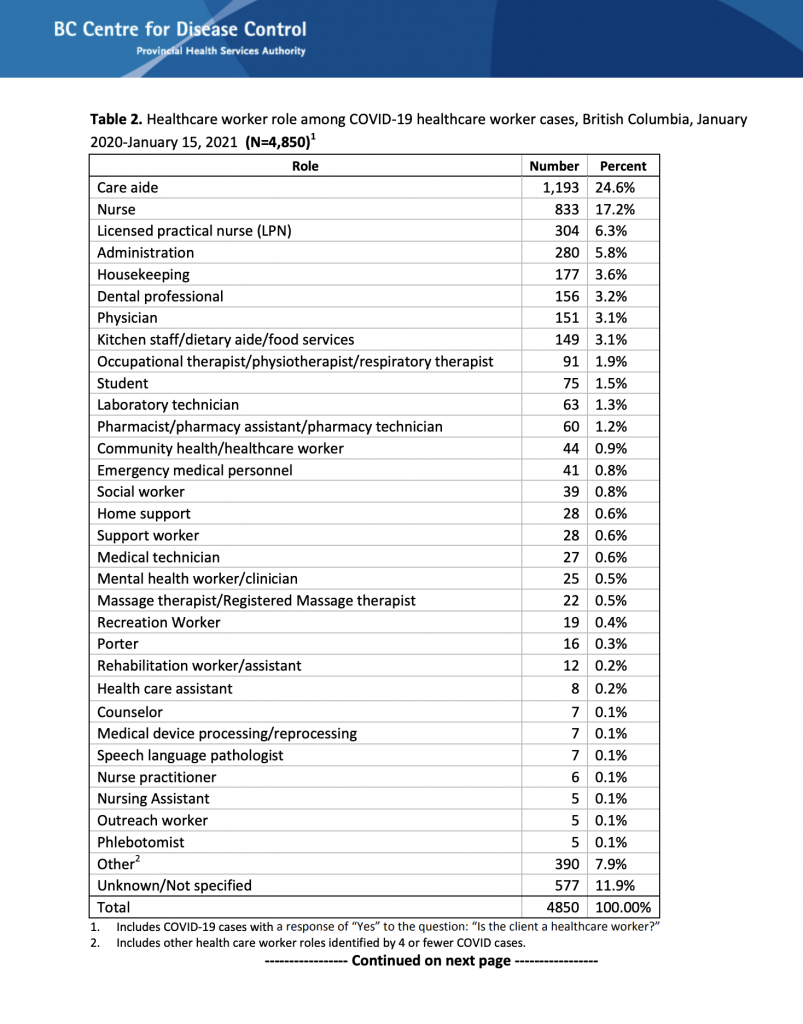
]]>COVID-19 infections continue to rise amongst B.C. healthcare workers as data just released shows the cumulative number of infections rose 34% in the past month, to 4,850.
The count provided by the B.C. Centre for Disease Control only goes up to January 15 when there were a total of about 60,000 COVID cases in the province. As of today, there are over 68,000 cases so it is likely there have now been somewhere around 5,400 infections among healthcare workers since the pandemic began. In mid-December, there were 3,624 cumulative cases among healthcare workers.
The good news, if you can call it that, is that COVID-19 infections among healthcare workers continue to account for just over eight percent of all cases in B.C. That proportion has not risen for a few months. As well, first vaccinations have been completed among all staff and residents of long-term care facilities so infections in LTC sector staff should start to fall.
Care aides who most commonly work in LTC facilities and nurses in various categories – RN, nurse practitioner and licensed practical – continue to head the list. As you will see from the table below, care aides account for about 25% of all infections in the healthcare sector while nurses are a close second, accounting for another 24%.
Cases among dental professionals (156) slightly outnumber those in physicians (151). The only professionals who’ve been vaccinated so far in B.C. are those who work in intensive care units, emergency departments and COVID units. That means healthcare workers like nurses, dentists and physicians not providing direct care to COVID-19 patients have not yet been inoculated.
The government and Dr. Bonnie Henry continually emphasize that not all COVID infections are contracted on the job. But it is clear that wherever healthcare workers acquire COVID-19, they are vulnerable and carry a heavy burden when it comes to the virus. A category called unknown/unspecified has 577 cases. That means individuals answered yes when they were asked during testing if they worked in healthcare but they declined to provide more information about their occupation.
In an ideal world, every healthcare worker would be getting vaccinated now. But the supply for most of February has dried up because of modifications to vaccine production facilities in Belgium.
 RELATED ARTICLES:
151% rise in COVID-19 cases in healthcare workers
Steep rise in COVID cases in healthcare sector
25% of COVID cases have been in healthcare workers
Growing number of cases among healthcare workers
The post COVID-19 cases rise 34% among B.C. healthcare workers in past month alone appeared first on Medicine Matters.
]]>The post Pre-surgery testing being used to curb COVID-19 outbreaks in hospitals appeared first on Medicine Matters.
]]>A new and significant COVID-19 outbreak on a surgical ward at Royal Inland Hospital in Kamloops is a wake-up call to not only wear masks and PPE but to conduct COVID-19 tests on all pre-surgery patients.
One patient has died out of 19 patients infected so far. Another 29 cases are among staff for a total of 48 cases.
There are 38 outbreaks in healthcare facilities across B.C. right now – 29 in long term care and nine in acute care hospitals. I have long questioned why COVID testing isn’t done on all pre-surgery patients. I’ve written about this often (see links below). Inexplicably, Provincial Health Officer Dr. Bonnie Henry has been opposed to widespread rapid and other testing among those without symptoms. She thinks pre-screening questions about symptoms or possible exposures are sufficient.
“We aren’t going to test for no purpose. That is wasteful,” she has said on various occasions. Today she acknowledged this: “It’s challenging to know when people are incubating the disease.”
We now know, however, that as many as a third of those who have COVID are asymptomatic. That, compounded with the fact that B.C. is a laggard when it comes to testing, is a recipe for outbreaks. B.C. has the lowest rate of testing among all provinces with a population of over one million, as shown by this CBC graph:
The good thing is that one health region has taken matters into its own hands. When COVID-19 cases started surging in the sprawling Fraser Health region last year, surgeons and other hospital leaders determined it was time to start testing patients requiring urgent and non-urgent operations.
They realized that pre-surgery testing, even in the absence of symptoms is absolutely necessary and not a waste of resources.
Some readers may have seen a recent Canadian Press story about pre-surgery testing in Fraser Health. It was confusing and conflated figures so I will attempt to clear this up although Fraser Health has been slow to respond to all my questions.
What we know is that two pilot studies have been initiated – one in emergency departments and one for elective surgery patients. All patients who go to Fraser Health hospitals for any reason are screened for signs and symptoms of COVID-19. They are also asked if they’ve had any exposure to COVID.
The rote screening process is far from perfect and misses those who may be asymptomatic.
In the pilots, all patients admitted to hospitals through emergency departments and deemed to need surgery were tested for COVID. Over a four-week period, 65 individuals needing urgent surgery, or 1.7% of all those who didn’t meet screening criteria, tested positive. That means that 65 seriously ill people could have caused outbreaks, risking the health and lives of health professionals and other patients. Fraser Health has not released the proportion of patients who still tested positive even after raising no flags on the pre-screening questionnaire.
During a three week period of the pilot study for elective surgery patients, 11 – or 0.4% – were positive for COVID. Fraser Health has not divulged what proportion of patients who passed the pre-screens tested positive however “identifying these individuals as being infected with COVID-19 ensured they were managed appropriately, with infection control measures to protect other patients and staff in place.” One presumes such patients were sent home to recover before getting their surgery but Fraser Health has not responded to that question.
“Given the high prevalence of COVID-19 in our communities and outbreaks occurring in both acute and long term care, these enhanced testing programs will remain in place at the present time,” added the statement from Fraser Health.
There are currently 19 outbreaks in longterm care facilities and hospitals in Fraser Health. That’s half of all the outbreaks in healthcare facilities in the province today.
To reinforce the importance of what Fraser Health is doing, in its small pilot study, there were dozens of patients identified through testing who might otherwise have infected healthcare professionals and other patients. And since research has shown that COVID raises the mortality risk of patients undergoing surgery, patients are better off having their operations delayed until they’ve recovered.
All other health authorities should follow the Fraser Health lead without delay.
RELATED LINKS:
NO PRE-OPERATIVE TESTING. IT’S CONTROVERSIAL.
PRIVATE SURGERY CENTRE WANTS PATIENTS TO GET TESTED
NO TESTING BEFORE SURGERY. IS IT LIKE ROLLING THE DICE?
151% RISE IN COVID AMONG HEALTHCARE WORKERS
The post Pre-surgery testing being used to curb COVID-19 outbreaks in hospitals appeared first on Medicine Matters.
]]>The post Surrey company gets federal approvals for medical grade respirator masks appeared first on Medicine Matters.
]]>BY PAMELA FAYERMAN
A B.C. medical mask company has received Health Canada and other quality standard approvals for its locally manufactured, four-layer masks.
The ECAN95 mask by Eternity Medical Equipment is the Canadian equivalent to the more commonly known N95 mask, an American designationl. This is reportedly the first Canadian-made respirator mask to gain such approvals by the federal government.
Jeffrey Wang, co-founder of Eternity, which opened three months ago in Surrey, said today:
“We are proud of our masks and pleased that our ECAN95 is the first Canadian-made mask to receive official CSA (Canadian Standards Association) certification. We started this journey back in April, and to know our masks are now being used across British Columbia and the country to help fight the pandemic is very humbling to us.”
The B.C. government has purchased over eight million medical masks for hospitals and healthcare staff from various producers since the pandemic began and now it has a local source. Although the fabric materials are imported, the masks are manufactured and assembled in Surrey and a surprising amount of the stitch work is done by hand.
Premier John Horgan praised the company in this message a few months ago:
Tested at the CSA laboratory in Toronto, the masks manufactured by Eternity were found to comply with required tight fit specifications, airflow resistance and filtering efficiency.
In a statement, Dana Parmenter, Vice President, Industrial, CSA Group, said:
“We are pleased to have certified this new product. Certification demonstrates that the tested PPE samples meet critical safety standards, and the manufacturer must maintain these standards throughout ongoing production. CSA Group is proud to be the first Canadian provider of testing, inspection and certification services for medical-grade PPE intended for use across Canada.”
As reported here, Eternity was one of the first companies in British Columbia to set up a production facility for masks in a sanitary plant with air showers at entrances, a dedicated filtration and exhaust system and air-conditioning purification. The company says it has the capacity to make up to 2.5 million masks a month at full capacity.
On Twitter, public relations consultant Sophia Cheng posted this:
Email: [email protected]
The post Surrey company gets federal approvals for medical grade respirator masks appeared first on Medicine Matters.
]]>The post Vaccinations in acute care hospitals fade as priority shifts to long term care sector appeared first on Medicine Matters.
]]>A Fraser Health physician leader, Dr. Dayan Muthayan, circulated an internal memo to doctors and other healthcare professionals recently, asking for their help as COVID-19 immunizers. The plea, right around New Year’s, produced instant results, a good thing since no other health region in B.C. has been as hard hit by COVID-19 as Fraser Health.
The region accounts for two-thirds of all the COVID-19 cases in B.C. since the pandemic began. Of late, the test positivity rate has been hovering around 10%.
Many hundreds of doctors, nurses, and pharmacists answered the call by Muthayan, the executive medical director of Fraser Health. But after only three days and 1,200 vaccinations, the clinic at Royal Columbian Hospital where the Pfizer-BioNTech vaccine was being distributed to frontline health care workers was shut down. One of the doctors – Dr. Kathleen Ross, the former president of Doctors of B.C. – vented her frustrations on Twitter:
I asked Ross the next day for more information and she said she was “politely asked not to engage (with) the media.” Another way to say muzzled.
Throughout the pandemic, doctors have taken to Twitter to share their knowledge, opinions and frustrations. And all too often they’ve been silenced. Some hospital staff like emergency room physicians have been threatened with firing if they speak out.
So it was good to get 15 minutes on the phone with Dr. Victoria Lee, CEO of Fraser Health today. She said she was happy to see how many hundreds of physicians and other health care professionals offered to do inoculations. “The response was tremendous. Everyone is stepping up and leaning in.”
She said that while healthcare staff in emergency departments, COVID-19 wards, and intensive care units at four hospitals – Abbotsford, Surrey, Burnaby and Royal Columbian – were the focus of vaccinations from the middle of December through the first week of New Year’s, the priority now is residents and staff in long term care and assisted living residences, especially because there isn’t an abundant supply of the vaccine.
Lee’s Twitter posts are decidedly more positive in tone than those from frustrated frontline health care workers:
A sizeable chunk of healthcare professionals have gotten COVID-19, especially care aides in long-term care facilities who’ve unwittingly transmitted infections to residents, resulting in outbreaks. Yesterday, the B.C. government finally offered more information on those outbreaks in care facilities, unveiling a new system to improve transparency. Two-thirds of the 988 deaths caused by COVID have been among elders in long term care.
Lee said like jurisdictions around the world, B.C. is at a “dire stage and whether we have vaccine or not, we need to maintain our vigilance.”
Dr. Bonnie Henry, the provincial health officer, revealed the priority groups for each stage of vaccinations, including 30,000 health-care workers by the end of February, providing vaccine supplies are constantly refreshed.
“We are constrained by logistics and also by how many vaccines we are receiving, but we’re optimistic, and we are focused intensely on making sure we protect people in long-term care and assisted living as quickly as we possibly can – and of course, protecting those most at risk in our communities,” she said.
B.C. had administered 46,259 COVID-vaccines to date, 65% of the 71,200 doses received so far.
Every province is struggling with vaccine supplies. In Ottawa today, Public Services and Procurement Minister Anita Anand said she’s been pressing vaccine manufacturers to expedite supplies and deliveries.
“I have spoken with the CEOs of both [vaccine] companies this week already, and I will continue to engage with them, as will my department, to move up doses from Q3 to Q2, from Q2 to Q1,” said, referring to the quarters of the calendar year.
Maj.-Gen. Dany Fortin, the military commander leading vaccine logistics for the Public Health Agency of Canada, said Canada is expected to receive four million doses of the Pfizer-BioNTech product and two million Moderna shots by the end of March — enough to vaccinate just three million people.
Here’s a detailed memo sent by the Fraser Health communications department, regarding that health region’s plans:
“We are currently in the first stage of the vaccine rollout across Fraser Health, with work well underway to vaccinate staff, medical staff, residents, and essential visitors in long term care and assisted living facilities, people awaiting long term care placement in acute and community settings, and priority acute care staff, medical staff and paramedics. We expect all eligible long term care and assisted living staff, medical staff and residents in the region to receive their first COVID-19 vaccination by mid-January.
Priority acute care health care workers include staff, medical staff and dedicated support services in emergency departments, critical care units, and COVID-19 units. We expect to immunize more than 6,000 of these priority staff and medical staff at acute care sites by January 23.
Dedicated immunization clinics in acute care began with our three regional COVID-19 hospitals – Surrey Memorial, Abbotsford Regional and Royal Columbian Hospitals. Burnaby Hospital also began immunization clinics this week, given the ongoing and significant outbreaks at that site. Remote First Nations communities will begin receiving vaccinations on January 13.
Over the next few weeks, we expect to immunize 12,000 to 15,000 individuals per week, and by February, we expect to be able to immunize up to 30,000 individuals per week.
We are grateful for the tremendous response from our staff and medical staff, as well as community physicians, local pharmacists, and other community partners who have stepped up to help administer the COVID-19 vaccine in our region. To date, nearly 550 medical staff, more than 75 pharmacists and 200 peer immunizers have expressed interest in administering the COVID-19 vaccine. In addition, Fraser Health has hired 60 dedicated immunizers and has redeployed additional staff to support our efforts.
Thanks to the efforts of our vaccine coordination centre and all those who have come forward to support immunizations, we have rapidly expanded our daily capacity from a few hundred to over 2,800 immunized per day as of yesterday.
Due to the numerous complexities of the vaccine rollout, our vaccine coordination centre teams are working around the clock to rapidly adjust and augment our schedules and strategies. We ask for the patience of those in our priority groups who are awaiting their vaccine as we endeavour to deliver an effective and efficient COVID-19 vaccine program.
Our vaccine coordinating and local Royal Columbian Hospital teams have done an incredible job with onsite vaccine clinics. As they had substantially completed their efforts to vaccinate priority acute care staff, medical staff and dedicated support services staff, a previously scheduled vaccine clinic at Royal Columbian Hospital was redirected to support our efforts to prioritize vaccination of our long term care and assisted living staff, medical staff and essential visitors.
Stage two of the vaccine rollout will begin before the end of January and will include broader groups of staff and medical staff who work in the health system.”
The post Vaccinations in acute care hospitals fade as priority shifts to long term care sector appeared first on Medicine Matters.
]]>The post 20 of the most read posts in 2020 appeared first on Medicine Matters.
]]>I started this website last May when it was clear that COVID-19 was a serious threat that would persist for a long time and require news coverage by experienced medical journalists such as myself. It’s gratifying to see how many readers are drawn to the site and I thank you for your interest.
I write most of the articles but submissions are also accepted so if you’re a healthcare provider, researcher or policy expert keen to share your expertise, do reach out.
While COVID-19 is the main topic for this website, any issue in healthcare is considered for publication as long as it adds to our collective knowledge. Article suggestions are also welcome.
As a health/medical journalist for 25 years, I’ve long had a tradition of posting an annual list of the articles that have drawn the highest metrics (readership). Here, then, are the posts that resonated the most with readers in 2020; click each title to read the piece:
2. Private mobile lab service offering COVID-19 tests
3. 25% of COVID-19 cases have been in healthcare workers
4. COVID-19 long haulers plead for more medical attention
5. Medical regulator shuts down private COVID tests
6. Ribbons around a giving tree for a nurse with COVID-19
7. Queue jumping for COVID vaccinations
8. Gargle and spit for COVID tests
9. 15-minute-pre-flight-rapid-covid-19-testing-launches-today-in-vancouver-for-westjet-passengers/
10. Can dogs sniff out COVID-19? Veterinarians conduct that research
11. 150% increase in COVID-19 infections among healthcare workers
12. Filipino healthcare workers hit hard by COVID; we need to know
13. Doodles while on Zoom; Vancouver professor shares hers
14. Family doctors as frustrated and frazzled as their patients
15. Married Vancouver physician leaders chat over Zoom with Rabbi
16. COVID-19 testing before surgery
17. Rapid testing in long term care
18. The special exemption Dr. Bonnie Henry ordered for COVID-19 research
19. More than 800 COVID-19 infections in healthcare workers; full breakdown here
20. Not one passenger has gotten COVID-19 on WestJet according to airline and airport authority
The post 20 of the most read posts in 2020 appeared first on Medicine Matters.
]]>The post Queue jumping for liquid gold: COVID-19 vaccinations appeared first on Medicine Matters.
]]>As of today, healthcare workers and residents in long term care will be the priority for COVID-19 immunizations – a most precious resource due to limited supply and great demand.
There have been reports of brazen queue-jumping all around the world.
In British Columbia, there are about 70,000 residents and staff of long-term care and assisted living facilities in B.C. and as of this week, they are the focus of immunizations with the Moderna vaccine. An internal memo to Vancouver Coastal Health, obtained by MedicineMatters.ca, attempts to quiet the criticisms by some who believe there have been stumbles at the start of the vaccination campaign.
As I reported in my last article, frontline healthcare workers who’ve accounted for a 151% increase in COVID-19 infections in just the last six weeks, were lining up for hours on their days off at a “pop up” clinic near Vancouver Hospital last week. As well, BC Nursing Union president Christine Sorensen told CBC that administrators have jumped the queue even though they don’t provide direct patient care.
But as I reported here, administrators who work in health care have been hard hit by COVID too, accounting for 204 cases as of Dec. 17. That’s six percent of all B.C. cases among those who work in health care. They didn’t necessarily get infected at their workplaces and the same can be said for all care aides and nurses who together account for the most cases among healthcare workers.
The controversies could die down a bit over the next few weeks as the aforementioned memo from pandemic planning leaders Dr. Ross Brown and Dr. Chad Kim Sing (below) makes it clear that long term care (LTC) staff and residents are now the priority since the vast majority of deaths have occurred in seniors residential care. The referenced meeting called for Jan. 20, 2021, could have some fireworks. Here’s the internal memo to VCH staff:

Just over 8,000 vaccinations have been completed in B.C. before Christmas and the goal is to complete 400,000 by March, 2021.
These are B.C.’s plans for vaccinations, based on recommendations from the National Advisory Committee on Immunization:
First priority groups
- Long-term care and assisted living facility residents and staff
- Health care facility staff for COVID-19 patients in settings like Intensive Care Units, COVID-19 wards and emergency departments
- Indigenous people living in rural or remote communities
- High-risk people living in group settings like shelters
- People over 80 years old
Second priority groups
In spring 2021, as more vaccine becomes available, the second phase of vaccination will begin for:
- Older people under age 80 in descending five-year-age groups, with a focus on the oldest people first
- Key frontline workers including:
- All other healthcare workers
- Police
- Fire and first responders
- People working in grocery stores
- People working in K to 12 education settings and child care providers
- People working in transportation
- People working in manufacturing and production facilities
Feel free to email me with tips and queries: [email protected]
The post Queue jumping for liquid gold: COVID-19 vaccinations appeared first on Medicine Matters.
]]>The post 151% rise in COVID-19 cases among healthcare workers in just six weeks appeared first on Medicine Matters.
]]>Vancouver hospital and other frontline health workers lined up for hours the other day to get vaccinated against COVID-19. They were reportedly told to get inoculated on their days off but from what I saw and heard, many were turned away because there were just too many to accommodate.
Asking healthcare professionals to line up for hours on their days off seems unacceptable given all their sacrifices during this pandemic. Online bookings are now being offered as an alternative to walk-ins at clinics in Vancouver, Richmond and North Vancouver. Clearly, Vancouver Coastal Health needs to do a good job scheduling thousands of appointments, especially since the latest report by the B.C. Centre for Disease Control shows that the total number of COVID-19 cases among B.C. healthcare workers rose to 3,624 from 1,442 when I last reported the figure six weeks ago.
That’s a whopping 151% increase.
Once again, topping the list of healthcare worker (HCW) roles among the COVID-19 cases is care aides, most of whom work in long term care. They account for 848 cases since the pandemic began – 23% of all the cases.
The next hardest-hit category is nurses. Registered nurses, nurse practitioners and licensed practical nurses account for 836 cases. Among others providing healthcare, there have been 138 dental professionals infected; 124 physicians; 62 occupational therapists, physiotherapists, and respiratory therapists; 49 working in pharmacies; and 37 emergency medical personnel. The complete chart is below.
It would appear that many HCW are reluctant to disclose their roles when asked during testing as there are 455 cases in the unknown/unspecified category and 306 cases in categories in which there were four or fewer COVID cases. Together, these groups account for a large proportion -21% of cases.
The data I requested covers the period up to Dec 17 when, on that day, there were a total of 44,776 lab-confirmed cases in B.C.
As of today, Christmas Eve, there have been 48,609 lab-confirmed cases of COVID-19 since the pandemic began and 808 deaths in B.C.
The data provides a clear validation of the approach being taken by the government to put HCW at the head of the line for vaccinations. Healthcare workers account for at least 8.1% of COVID-19 cases in B.C.. a substantial decline since the beginning of the pandemic when about a quarter of all cases were among HCW.
It is important to note that infections may have been acquired outside work settings (hospitals and other healthcare facilities). That is a point that Dr. Bonnie Henry has repeatedly stressed.
Click here to see the year-to-date epidemiology update delivered by Dr. Bonnie Henry today. Click here to see previous articles about COVID in healthcare workers.
More on the vaccination clinics: An email sent tonight from Vancouver Coastal Health spokeswoman Rachel Galligan says additional resources have been committed to ensure healthcare workers get vaccinated “efficiently and safely.
“There are a number of logistical considerations and challenges in managing an immunization campaign of this scale. Also note, some healthcare staff arrive at vaccination clinics by shuttle bus. This can lead to a temporary queue, however, registration is completed quickly. Our immunization program continues to prioritize those most vulnerable to COVID-19, including residents and staff at long-term care homes.”
Here’s the chart from the BCCDC showing how many COVID cases there have been so far in each category of HCW:
The post 151% rise in COVID-19 cases among healthcare workers in just six weeks appeared first on Medicine Matters.
]]>The post Surrey hospital tracking COVID-19 and other ICU patients after discharge for rehab needs appeared first on Medicine Matters.
]]>BY PAMELA FAYERMAN
Since the pandemic began, well over 100 patients have survived COVID-19 after being treated in the Surrey Memorial Hospital intensive care unit.
Many of them have ongoing medical problems and will require hospital readmission within a month – 30% at three months, 40% at six months and 50% within a year if statistics on survivors of other critical illnesses apply.
Dr. Greg Haljan, head of the SMH critical care unit (CCU) is spearheading research delving into the role of virtual health care for pulmonary and other rehabilitation aimed at discharged patients. Researchers want to learn what types of interventions might reduce the number of rehospitalizations and improve the quality of life and overall health of patients who were discharged. Haljan, who is also the Regional Medical Director of Research for Fraser Health, intends to examine whether a virtual recovery program providing pulmonary rehabilitation for COVID-19 survivors reduces the rate of repeated hospitalizations, patient quality of life and health outcomes.
Patients who don’t have primary care physicians, he said, have the greatest need for follow-up care.
Haljan and his research team have received more than $300,000 to do the Virtual Health Care Rehab Clinic feasibility study.
Early in the pandemic, Haljan anticipated the need for home monitoring so he loaded up on instruments like blood pressure and heart rate monitors, weight scales and pulse oximeters for patients to use.
“I got them in February, all on Amazon before they started selling out,” he said in an interiew.
Haljan led a collaborative project with the SMH emergency department which involved following discharged patients at home. They were phoned daily and urged to return to the hospital if their health deteriorated. The feasibility study helped researchers understand more about the needs of people who’ve survived a critical illness and been on a ventilator.
“These ICU followup clinics – critical care survivors clinics – are hard to do since we are hospital doctors, not docs in the community,” he said.
Getting discharged from an ICU is tough on patients and their families. Many experience depression, anxiety and post-traumatic stress disorder as patients are left with physical and cognitive disabilities.
“There’s growing recognition of care and complications of the disease, what we call post-ICU syndrome, and that includes COVID-19 patients we’ve seen, even those who didn’t require life support. We aren’t a COVID long haul program, we are an ICU survivorship program, to be clear.”
For COVID long-haulers – those who suffer symptoms and effects of the virus for many months after they ere first infected – there is a great need for clinics where they can seek help. So far, there are clinics at Vancouver General Hospital, St. Paul’s Hospital, and soon, Surrey and Abbotsford hospitals.
Shortness of breath is often a problem with patients who’ve been on ventilators and so is muscle weakness and blood oxygen levels. Said Haljan:
“You can liken being on a ventilator to being in a cast for a broken bone. You lose muscle mass every day, and that includes breathing muscles. So standing up, turning your head, even just breathing is hard. The intubation has caused a direct injury so the voice and breathing is all part of that physical reconditioning,
“Shortness of breath causes a lot of anxiety so there’s a psychological component to this. People start to breathe fast and end up using more oxygen. They may experience joint problems, arthritis, inflammation, brain fog like what we call chemo brain in those on cancer therapy.”
Post ICU rehabilitation for COVID and all other patients has been a missing element in health care and Haljan said that needs to change.
“Like all patients who’ve had life-threatening pneumonia, we know COVID inflames blood vessels and causes injuries. Different diseases have similar issues that require long term rehab support. Most rehab has been focused on what we can measure – sit to stand exercises that measure strength, for example.
While the program is still being designed, Haljan said he thinks it will use a coaching approach because that seems to actively engage people. “They can set some personal goals and we can come up with a program that helps achieves goals, just like what is done in cardiac rehab after heart attacks.
“Pulmonary rehab, however, had s traditionally been harder to get patients to stick with. I don’t know if an exercise prescription is right, it may require layers of various approaches.”
The program is still under development but it’s expected the base will be the Jim Pattison cardiac care unit. The health professionals will be there but they will offer virtual care to patients in their homes. The $300,000 is funding the research infrastructure space, and for various health professionals – a lab, pharmacy research coordinator, and nurse.
“We are making our own virtual platform. a sort of Zoom or Facetime type. The initial engagement will be with a nurse or doctor to see how the discharged patients are doing. We can make referrals to medical specialists and then offer a functional assessment by a physiotherapist, then a coaching process that shows patients what to do, give them pointers, and track their progress. Their abilities and out capacity may dictate how many sessions are offered – maybe it’s two or three times a week or once over three months,” he said.
The Surrey Hospitals Foundation is funding COVID-19 medical research through an investment of $150,000, and a $150,000 matching grant from the Michael Smith Foundation for Health Research (MSFHR). Seed funding of $25,000 came from the TELUS Friendly Future Foundation.
“We are facing a healthcare crisis with COVID-19 and it is absolutely critical for us to invest in COVID-19 research to improve the health outcomes of patients,” said Jane Adams, President and CEO of the Surrey Hospitals Foundation. (Adams is in the photo on left).
“We are so grateful to the Michael Smith Foundation for Health Research for this timely grant and we are proud to support COVID-19 research initiatives and the establishment of this COVID clinical research team in Surrey.”
Established evidence shows that mobility and rehabilitation, after being discharged from the hospital, (can) reduce mortality and acute care utilization in patients who survive hospitalizations for critical illnesses.
The post Surrey hospital tracking COVID-19 and other ICU patients after discharge for rehab needs appeared first on Medicine Matters.
]]>