The post SWISH & GARGLE COVID-19 TESTS: B.C.’s pioneering work appeared first on Medicine Matters.
]]>COVID-19 test collection sites say some individuals are showing up unprepared for the more comfortable saline gargle test which means they can’t use the alternative to nasal swab testing.
Those who want COVID-19 saline gargle device must avoid eating, drinking, vaping or smoking, brushing their teeth or chewing gum for at least one hour prior to taking this test. Otherwise, the test won’t yield an accurate and reliable result.
The test is done by swishing and gargling saline water in the mouth for 30 seconds under the supervision of a test administrator.
It is currently available at 14 test collection sites across urban and rural Vancouver Coastal Health communities. It accounts for just over 30% of all COVID-19 tests performed in the region. Test collection sites are listed on the VCH website.
The BCCDC has published a simple video guide for parents and caregivers to show how they can practice with their child, before they arrive at a COVID-19 test collection site. A video with guidance for adults has also been created. VCH advises waiting at least two hours between practicing and doing the actual test collection to avoid affecting test results.
Here’s a story about how the testing was developed:
BY PAMELA FAYERMAN
Not long after the pandemic began, it became apparent the supply of swabs required for collecting nasopharyngeal (NP) samples could become insufficient because of global demands and inadequate supply chains.
Experts also identified other issues with the long swabs. They can be uncomfortable and even traumatic for some, not to mention they pose a risk to healthcare technicians testing individuals because the probes can provoke gagging and coughing in those being tested.
In July, this website reported on the growing global shortage of nasal swabs and preliminary research being done around the world on less invasive saliva sampling showing comparable accuracy to swab tests.
Officials at the B.C. Centre for Disease Control followed the work being done elsewhere and three months ago, became one of the first jurisdictions in the world to introduce a saline rinse-gargle method for COVID-19 testing. The saline gargle was initially introduced as an alternative to nasopharyngeal (NP) swabs for school-aged children. But last month, it became available to adults as well.
The testing is done by swishing and gargling salinated water and then spitting it into a tube.
In the current BC Medical Journal, four provincial experts discuss the work that led to this point.
Meghan McLennan, of Provincial Laboratory Medicine Services; Dr. David Goldfarb, MD, a Medical Microbiologist who is associate head of the Department of Pathology and Laboratory Medicine at BC Children’s & Women’s Hospitals; Michael Donoghue of the UBC Centre for Disease Control; and Dr. Linda Hoang, a Medical Microbiologist and Associate Director of the BCCDC Public Health Laboratory, state:
“Saliva was the most common swab-independent alternative at the time; however, some patients struggle to provide an adequate volume, and saliva is a difficult specimen type for laboratories to handle. Also, the mucoid nature of saliva was not ideal for the laboratory and required additional processing steps for the sample to be polymerase chain reaction (PCR) ready.”
They scanned medical literature and found “limited and vague” reports of mouthwash-type samples for testing other viruses. They identified saline gargle as a highly possible option.
“Laboratory testing of PCR performance, stability, and appropriateness of the saline gargle was evaluated. Saline gargle performed well compared to the standard nasopharyngeal swab and viral transport media system.”
The validation process was done at BC Children’s Hospital where children getting COVID-19 testing had NP swabs, saline gargle, and saliva specimens. The validation showed test results were equivalent for the NP swab and saline gargle, while saliva had lower clinical sensitivity, especially in children. As well, children ranked the saline gargle collection as the preferred method.
The next step was a province-wide study involving all COVID-19 testing laboratories to confirm that saline gargle specimens were compatible with all COVID-19 nucleic acid-based testing platforms. The validation exercise ended just as schools were ramping up to accept students back, timely because everyone recognized that in-person learning would mean more children would require COVID-19 tests.
“Testing by collecting an NP swab can be traumatic for children, parents, and health care workers, but using the less-invasive saline gargle helps to lessen barriers to testing,” the authors note.
The provincial implementation started a week after children returned to classrooms.
Online videos and instructions were created. Parents are advised they must practice the technique with their children at home with a solution of salt and water. “This is especially important for young children who, initially, often immediately spat out the saline solution because of its saltiness. If that happens, individuals must either wait two hours before trying the saline gargle again or get tested with the NP swab.”
There are important instructions for anyone seeking the newer tests:
- You cannot eat, drink, vape, smoke, brush your teeth, or chew gum for at least one hour before taking the test.
- If you want to use the mouth rinse and gargle test, you must review the information on this page first.
The authors say that their work has helped jurisdictions across Canada and abroad adopt the saline gargle method in their regions.
This is knowledge translation at its best.
The post SWISH & GARGLE COVID-19 TESTS: B.C.’s pioneering work appeared first on Medicine Matters.
]]>The post Family doctors are as frazzled & frustrated as their patients through the COVID-19 pandemic appeared first on Medicine Matters.
]]>BY PAMELA FAYERMAN
Family medicine is in a state of crisis, exacerbated by the pandemic which, eight months in, has totally disrupted primary care physicians’ ability to provide face-to-face, quality care.
Things are so bad that while governments are urging everyone to get a flu shot to avoid a “twindemic” many doctors and their patients are confused about where to get vaccinated, just days away from the time when people typically start getting them.
At a visit to my own doctor’s office last month (for a shingles vaccination by the clinic nurse) I was told that I would have to make alternate arrangements if I wanted a flu shot. Then I heard rumblings about drive-through flu clinics, maybe even in the same parking lots where COVID-tests are offered by health regions. But I heard today from the ministry of health that drive-through vaccination centres are not being contemplated in B.C. even though they are happening in other parts of the country.
Instead, flu shot appointments, according to the B.C. government, can be made at “clinics, schools, large municipal spaces, and pharmacies where physical distancing and other public health measures can be maintained, and where individuals can be observed after their shot for the standard 15 minute monitoring period.”
The government spokeswoman also directed me to this information about where flu shots are available in Vancouver – www.vch.ca/flu.
Indeed, it would seem that flu shots this year will be largely offered outside the offices of family doctors. Check health region websites for more information.
Dr. Maryam Zeineddin, a family physician in West Vancouver where she shares office space with six other colleagues, said her office won’t be offering any flu vaccination clinics because of pandemic limitations.
“In my clinic, we provide care to over 10,000 patients but we have no physical ability to bring so many of the patients in, given all the restrictions, cleaning protocols and requirements for personal protective equipment (PPE).
“We want to see our community vaccinated but this would require help from the Vancouver Coastal Health Authority. We need a proper space to do it and some administrative or nursing support plus help obtaining and funding the PPE.”
Doctors in private practices are obligated to source and buy their own PPE. But they don’t have supply chains that can, at a snap of the fingers, deliver high volumes of masks, gloves, gowns, and face shields.
“It’s been seven months and we still can’t access Canadian suppliers. We got some help from Vancouver Coastal Health – two boxes of masks,” said Zeineddin, who often uses bike goggles when doing riskier procedures to protect her eyes from COVID and other contagions. She said the costs of ordering massive quantities of PPE are prohibitive for family doctors, many of whom are struggling to hold on to their leases and medical office assistants.
“We are seen as business owners, but it’s not a business where we can set or raise our fees to offset the extra costs since our fees are regulated. So when our overhead goes up exponentially, I can’t make up the difference.”
Overhead costs have risen up to 30% during the pandemic and it’s easy to see how. Face masks each cost between 50 cents and a dollar; N95 masks are at least $2.00 each; face shields are $3.00 apiece; disposable gowns $2.00 apiece and then there are gloves, cleaning supplies, and costs associated with cleaners (now $2,000 per month, up from $1,200) because deep cleans must be done daily in offices where patients are visiting. Many offices have installed plexiglass barriers as well.
Doctors of BC has negotiated a one-time grant up to $1,000 for doctors’ offices to help offset costs of PPE. Each eligible physician can apply for the grant. Zeineddin said every bit helps but that’s a drop in the bucket.
“Even if they gave us $1000 per month, these costs are prohibitive and you will see many more doctors’ offices closing,” she said.
“In our practice, we are doing 50-50- inpatient and virtual care. I see four patients per hour but can’t keep up because of so many complex concerns that have piled up over the course of the pandemic. Patients have not had proper care for seven months. They’ve been getting prescriptions over the phone.”
An organization that represents family doctors in B.C. has released a report describing the many problems in the primary care system – problems exacerbated by the pandemic. Zeineddin said the report makes it clear that doctors are running on fumes. As independent business owners, they don’t have the same resources given to hospitals and the urgent/primary care clinics that the NDP government has opened across B.C. where doctors are mostly salaried and. Indeed, many doctors are choosing to work in such clinics because they don’t have to worry about office overhead costs.
“Family doctors are (also) choosing paths such as hospital or emergency care where infrastructure is covered by the government-funded system,” said Dr. Jennifer Tranmer, president of BC Family Doctors’
The report concludes with these recommendations and pledges for advocacy:
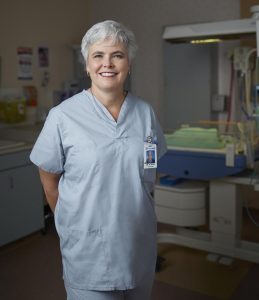
Dr. Kathleen Ross, President, Doctors of BC
Dr. Kathleen Ross, president of Doctors of BC, which advocates for primary care physicians as well as specialists, said the report highlights “the critical role family doctors have played in the pandemic response to date as well as the pressures and challenges that remain for frontline primary care providers.
“Where we diverge slightly … is in highlighting the many key supports Doctors of BC has worked on for family doctors both before and after the pandemic began,” she said mentioning. supports for office expenses through business cost premiums on fee codes – based on where in the province doctors practice and their practice type, incentive fees for family practices that provide longitudinal care, and consulting with the government on Alternative Payment Contracts for community-based family doctors.”
Doctors of BC has also worked to get technical supports and fee changes so that medical offices could rapidly shift from 90% of office visits being in-person to 90% being virtual care.
The Divisions of Family Practice lobbied hard for COVID testing and assessment centres “to divert patients with respiratory symptoms away from community offices, both to limit exposures to other patients, office staff, and physicians and to preserve and centralize our limited supply of PPE.”
It has also consulted with health authorities to share their PPE supply chains with offices that have had trouble accessing their usual supply chains due to the global shortage of PPE. As Zeineddin said, however, her medical office has only been able to access two boxes of masks.
Ross said she knows there’s plenty more work to be done to support primary care and that “is proceeding more slowly than some may want. However, meaningful change in our primary care system can only occur if all partners continue to work collaboratively. Doctors of BC remains committed to working with all our healthcare partners to address the remaining issues highlighted by the report.”
The post Family doctors are as frazzled & frustrated as their patients through the COVID-19 pandemic appeared first on Medicine Matters.
]]>The post More than 800 COVID-19 infections in B.C. healthcare workers; the full breakdown is here. appeared first on Medicine Matters.
]]>The B.C. government and BCCDC have finally responded to my request for a breakdown on the number of COVID-19 infections in healthcare workers.
As of August 8, the latest date for which data is available, 178 registered and licensed practical nurses in B.C. have tested positive since the pandemic began. Given historical trends (20 additional cases in each of the past few months among nurses), the number would, as of today, be closer to 200. The August 8 data shows an increase of 42 cases from two months ago when the number of nurses infected was 136.
Registered nurses account for 17.5% of COVID-19 cases in healthcare workers while licensed practical nurses account for 4.1%. The data does not distinguish between health professionals who were infected at work or outside health care facilities. It is often impossible to determine the source of infections but nurses have recently been granted
As of August 8, healthcare workers accounted for 17% of the 4,825 COVID cases on that date. As of August 24, there were 5,184 lab-tested or epi-linked cases in the general population, including 23 deaths.
As the chart above shows, the next most impacted category of healthcare workers is care aides – 129 infected compared to 95 two months ago. Nearly 300 individuals who work in long term care, in various capacities, have gotten COVID-19, according to the government. There have been 77 dental professionals affected by the virus, an increase of 10 cases from two months ago.
Forty-one physicians have tested positive, an increase from 35 cases two months ago.
Some of the data is rather non-specific; 205 cases representing 25% of all COVID cases in healthcare workers fall under a category called “other” which includes pharmacists. Another 80 are “not specified” because the healthcare worker did not provide that information at the time of testing. Without specifics, it’s impossible to know how many allied health professionals have potentially contracted COVID-19 at work – including pharmacists, massage therapists, physical therapists, chiropractors, and traditional Chinese medicine, for example.
The healthcare worker definition for these purposes includes all those who either provide care or who work in healthcare facilities so that can include students, volunteers, and those who work as support staff, in clerical roles, for example.
Housekeepers, paramedics, hospital/health facility kitchen staff, and laboratory technicians account for relatively low numbers of cases, a fact that should be somewhat reassuring to such healthcare workers and their employers.
BCCDC says only one health care worker has died since the pandemic began and it has been determined that exposure to the fatal COVID-19 infection occurred “outside the clinical work setting.”
RELATED ARTICLES:
Pandemic and Health Journalism
25% of COVID Cases Among Healthcare Workers
The Giving Tree for a Nurse with COVID
What is a Resolved COVID-19 Case?
The post More than 800 COVID-19 infections in B.C. healthcare workers; the full breakdown is here. appeared first on Medicine Matters.
]]>The post Nurses electing a new governing slate today, amidst union election controversies appeared first on Medicine Matters.
]]>The B.C. Nurses Union is one of the biggest – 48,000 members including registered nurses, registered psychiatric nurses, licensed graduate nurses, licensed practical nurses, employed student nurses, and other health care support staff.
It is also one of the most influential in B.C. Indeed, no government and no campaigning political party ever wants to be on the wrong side of the BCNU. (The provincial Liberals often were).
Later today or in the coming days, the union will announce a new slate of officers after an election campaign that featured the usual dose of controversies, most of them triggered by discontented nurses.
I’ve written about their elections, contracts, and negotiations over the past 25 years and can say, quite confidently, a journalist could carve out a full-time beat writing about the BCNU with stories like this one that I wrote last year.
Up until a week ago, there had been another nurse running against BCNU president Christine Sorensen but she dropped out, leaving Sorensen as the acclaimed president.
Health minister Adrian Dix with newly acclaimed BCNU president Christine Sorensen
From my view, Sorensen has done an impressive job since she took over as president amidst a controversy involving her predecessor.
As with many of the previous BCNU election campaigns, there have been allegations of dirty tricks that nurses have shared with me. Perhaps the most surprising came from union members who alleged conflicts of interest involving the company used to conduct the online balloting that began August 14 and closed earlier today.
Previously, the BCNU had used a Telus-affiliated company called Simply Voting but for this election, a newly formed company called Reliable Voting was used.
Allegedly, the wife of a lawyer used by the BCNU is a principal in the online ballot company.
I asked the BCNU about the conflict of interest allegations and whether the new company was properly vetted. BCNU Nominations Committee Chair Michelle Nelson said this in a statement sent through the communications and campaigns coordinator:
“BCNU’s elections are managed by the union’s nominations committee – an independent committee of nurse members who have been elected by their peers. The purpose of the committee is to conduct elections of the union and assume responsibility for all aspects of a fair and transparent election process.
“The complaint brought forward by a member of BCNU has been thoroughly investigated by the nominations committee. The union will not be commenting further at this time.”
In social media, Michelle Nelson, chair of the nominations committee, also fired off this warning shot a few weeks ago:
I asked Sorensen to comment on the allegations and she said they came from disgruntled members.
“A request for proposals went out for the election company. An independent body running our elections selected the company. It was all above board.”
She added the union contracts with independent lawyers as contractors, not as employees.
“It’s all above board and approved by the (nominations committee).”
Leave your comments below or Email me here: [email protected]
The post Nurses electing a new governing slate today, amidst union election controversies appeared first on Medicine Matters.
]]>The post Growing Numbers of Healthcare Workers with COVID-19 appeared first on Medicine Matters.
]]>The last time I wrote about the number of health care workers in B.C. who had been infected with COVID-19, the numbers were staggering.
They still are but the latest information obtained from the BC Centre for Disease Control (BCCDC) shows that the proportion of infections in healthcare workers like nurses, physicians, care aides and others has shrunk a wee bit, relative to overall lab-confirmed case rates in B.C.
In April, health care workers (HCW) accounted for 428 or 21% of COVID-19 infections in B.C. In early June, 680 infections were among healthcare workers – representing 25% of COVID-19 infections. As of early August (the latest data provided by BCCDC), 756 health professionals had tested positive for COVID-19 which represents about 20% of all lab-confirmed cases at that time period.
I’ll be adding a graph showing the breakdown of infections in various categories of healthcare when the information is supplied.
According to this report, there’s a huge variation in infection rates among healthcare workers between countries, with fewer than 1% in Singapore and more than 30% in Ireland. B.C.’s rate is certainly on the higher side.
Healthcare workers have been tested more often than anyone else and they’ve been in the line of fire so it is perhaps not surprising that nearly a quarter of all infections would be diagnosed among their ranks. In my last article, I wrote about a nurse at St. Paul’s Hospital in downtown Vancouver who got COVID-19 in late March and is still on sick leave.
Provincial health officer Dr. Bonnie Henry drew some outrage when she said this a few months ago: “I think we need to be cautious when we look at the healthcare worker data because we include healthcare workers no matter where they were exposed. Many people who are healthcare workers were exposed at things like a (March dental) conference that we know a lot of people attended. There was personal travel. There was also transmission between workers in settings where they may not have realized there was a risk — in lunchrooms, in break rooms, and things like that.”
Throughout the pandemic, nurses and other healthcare workers in acute and long term care settings have complained that one of the big reasons why their health has been threatened is because access to personal protective equipment (PPE) has been rationed or restricted, even locked away in cupboards. Requiring a unit manager to unlock the supply closet causes delays that potentially compromises the health and safety of healthcare teams.
PPE is intended as a barrier against infectious pathogens, blood, and body fluids that are hazards of the job in health care settings. It includes gloves, N-95 respirators, face masks and/or shields, eye protectors, gowns, headcovers, and booties. Health Minister Adrian Dix has been transparent about PPE acquisitions and the staggering costs of stockpiling supplies but healthcare workers have countered with anecdotes of PPE rationing that goes on in many health care facilities because of shortages or attempts to avert shortages.
Nurses contend that healthcare employers maintain they have the right to determine how much PPE should be donned. Nurses, on the other hand, maintain they must be allowed to use their clinical judgment to decide whether they need more than the bare minimum.
Christine Sorensen, president of the BCNU
Christine Sorensen, the recently acclaimed president of the BC Nurses Union (BCNU), has said throughout the pandemic that members have complained about insufficient access to PPE.
The BCNU has now published a position statement on PPE based on a concept in law called the Precautionary Principle. After the 2003 SARS outbreak which affected individuals in Ontario and B.C., an Ontario commission issued a report that said, in part, that the precautionary principle should help guide actions meant to protect healthcare workers. The BCNU says that under the precautionary principle, safety comes first.
“Imagine a firefighter having to delay response to a burning building while they seek permission to unlock their helmet and boots. This circumstance would be intolerable for those firefighters, just as it should be for nurses and other healthcare workers who may have their PPE stored in locked cabinets and not be provided with the keys.
“More plainly, this precautionary principle dictates that it is appropriate to use the highest level of PPE available until there is definitive proof that such PPE is not required.”
Healthcare workers are invited to share their comments about this issue in the area below or by emailing me: [email protected]
The post Growing Numbers of Healthcare Workers with COVID-19 appeared first on Medicine Matters.
]]>The post Ribbons around a ‘giving tree’ for a nurse who got COVID-19 appeared first on Medicine Matters.
]]>BY PAMELA FAYERMAN
On a day when B.C. reported the third-highest number of new COVID-19 cases since the pandemic began (85), a Vancouver hospital nurse who contracted the virus is shocked at the number of people “who still don’t respect the seriousness of this virus.”
“Don’t be fooled for a moment, it can take your life,” Amy Sangha said in a phone interview that was delayed a day because of lingering breathing problems that, five months on, prevent her from having long conversations, not to mention going back to work.
Sangha is one of nearly 150 nurses in B.C. who have gotten COVID-19 since the pandemic began. Her last shift worked at St. Paul’s Hospital in downtown Vancouver was on Friday, March 20. By the following Monday, a scheduled day off, she couldn’t walk up four stairs or hold a toothbrush to her mouth.
“I have no idea how I gathered the strength days later to drive to the Blusson Spinal Cord Centre (where health care staff went, at the time to get COVID tests), but I did and the results came back positive the next day.”
Sangha, who lives alone, was a transition services coordinator, a nursing role that involves hospital discharge planning for patients with complex illnesses and needs.
“I am certain I got COVID at work. Maybe from a patient at the time who was waiting for the results of their COVID testing, I don’t know for sure and I have no way of finding out.”
Just over a week after she was diagnosed with COVID-19, Sangha – who has no underlying health issues – was rushed by ambulance to Burnaby Hospital for a few days because her respiratory symptoms were so severe.
When she was in isolation at home in Burnaby, the 44-year old Sangha stared out her windows, fixated on a willow tree blooming in the Spring with yellow flowers. She had an unrelenting fever for two weeks and that tree in her front yard became her symbol of willpower and hope.
She doesn’t recall ever reading the allegorical book, The Giving Tree, but Sangha resolved that her tree represented life and growth and that it should also inspire a giving movement, for herself and her large circle of family, friends and other supporters.
“And then I thought maybe if it had ribbons, it could also lift my spirits.”
She made a sign she placed outside her house that read:
“Health-care worker being held hostage by COVID-19. Please tie a ribbon on the tree to keep my spirits up as I kick some COVID ass.”
People have not only tied ribbons – they’ve attached guardian angels to the tree limbs, crystals, and balloons. Everything remains intact and Sangha has no plans to remove the decorations.
On various social media channels, she announced that for every ribbon that friends, family members, neighbours or strangers tied on the tree, she would donate money to various causes – the Burnaby Hospital Foundation, Care Canada’s COVID-19 relief fund, and Doctors Without Borders.
There are so many ribbons that she ended up emptying and donating all that was in her savings account – $6,400. People around the world – complete strangers – also rose to the challenge. One gentleman donated $26,000.
“He’s anonymous. But in my fantasy, he’s a patient I took really good care of,” she says.
While COVID has ravaged her lungs and kept her away from a career she’s had for 20 years, Sangha is encouraged by the heartwarming support she’s been shown. Her union has also had her back, playing a pivotal role in sick leave benefit issues.
“There are many days when I’m in a dark place because of the lingering effects of COVID, the breathing difficulties, and exhaustion. I’ve got PTSD and I want my life back. It wears on you, psychologically and emotionally.
“My breathing never deteriorated to the point that I required ventilation, but when your breathing is so threatened, it is really traumatic because you know that if you stop breathing, you’re dead.
“I was afraid to go to sleep because I thought I may never wake up again.”
The sign Sangha posted on her lawn, in gratitude
The post Ribbons around a ‘giving tree’ for a nurse who got COVID-19 appeared first on Medicine Matters.
]]>The post BREAKING NEWS: BC CANCER FOUNDATION HIT BY CYBERCRIMINAL RANSOM DEMAND appeared first on Medicine Matters.
]]>The fundraising arm of BC Cancer is the latest charitable organization to be hit by cybercriminals who succeeded in a sweeping attack on Blackbaud, a software company that provides cloud services to health, faith, and healthcare charitable foundations around the world.
A growing number of high profile fundraising organizations are now alerting donors that their personal information (but not credit card information) has been compromised. The Washington Post wrote about one such organization – the George Bush Presidential Library – here.
Ransoms have been paid.
The ransomware attack occurred in May but donors are only learning of this now through emails.
Besides BC Cancer, there are other charitable entities now alerting donors; among them The Centre for Addiction and Mental Health in Toronto, Western University in London, and the Jewish National Fund (Canada). American news outlets have identified over 100 charitable organizations that have been affected.
Last year, 15 million Canadians in two provinces – Ontario and B.C. – were affected by a similar attack on LifeLabs. Coincidentally, news today revealed that LifeLabs is in court trying to block information from being released about security lapses that permitted the attack.
Readers of this post will be hearing more about the attacks in coming days but I wanted to immediately post the information in emails to BC Cancer Foundation donors here:
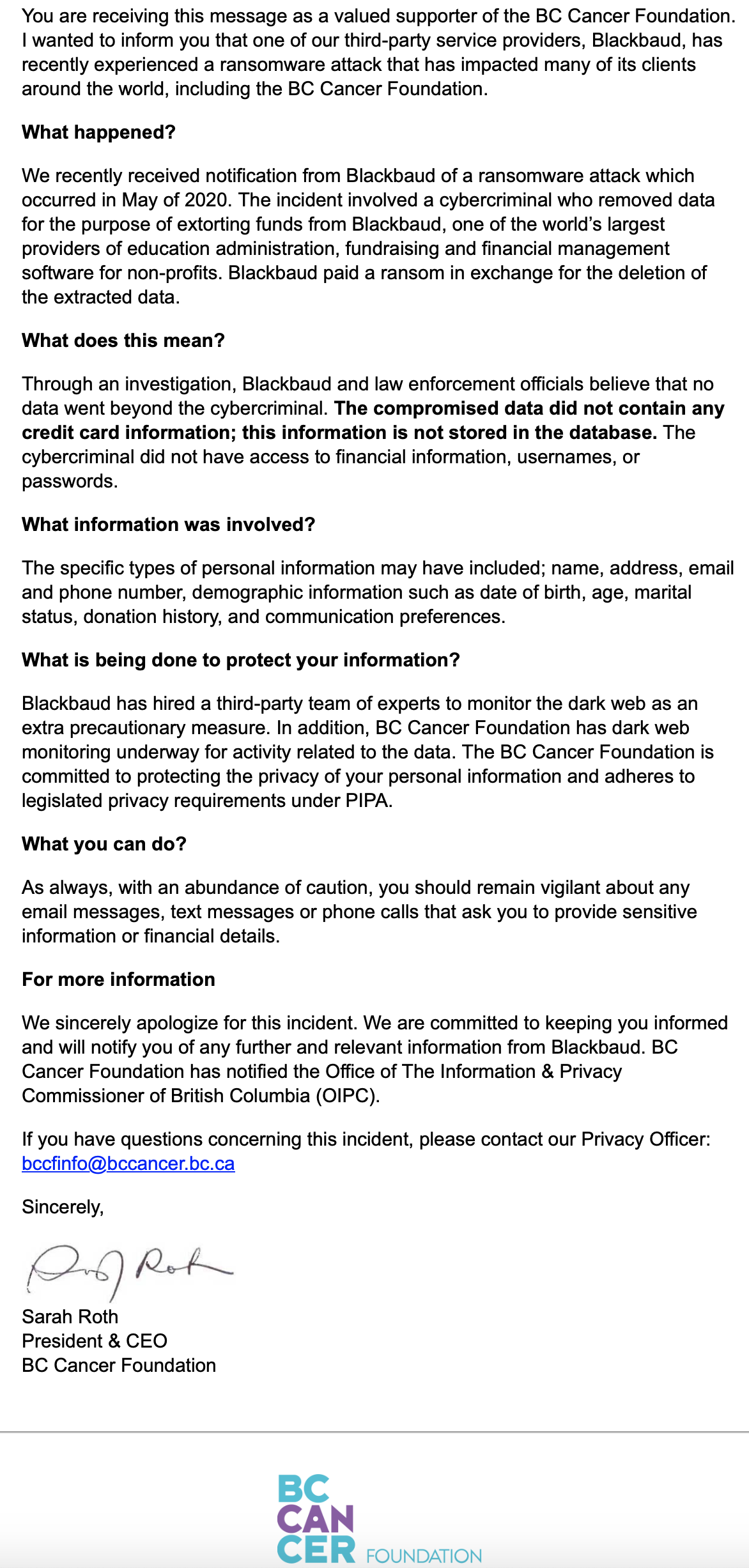
In a statement that almost downplays the cybercrime attack, Blackbaud reported the security breach on its website, stating:
“The Cybercrime industry represents an over trillion-dollar industry that is ever-changing and growing all the time—a threat to all companies around the world. Like many in our industry, Blackbaud encounters millions of attacks each month, and our expert Cybersecurity team successfully defends against those attacks while constantly studying the landscape to stay ahead of this sophisticated criminal industry. We wanted to notify our customers and other stakeholders about a particular security incident that recently occurred.
In May of 2020, we discovered and stopped a ransomware attack. In a ransomware attack, cybercriminals attempt to disrupt the business by locking companies out of their own data and servers. After discovering the attack, our Cyber Security team—together with independent forensics experts and law enforcement—successfully prevented the cybercriminal from blocking our system access and fully encrypting files; and ultimately expelled them from our system. Prior to our locking the cybercriminal out, the cybercriminal removed a copy of a subset of data from our self-hosted environment. The cybercriminal did not access credit card information, bank account information, or social security numbers.
Because protecting our customers’ data is our top priority, we paid the cybercriminal’s demand with confirmation that the copy they removed had been destroyed. Based on the nature of the incident, our research, and third party (including law enforcement) investigation, we have no reason to believe that any data went beyond the cybercriminal, was or will be misused; or will be disseminated or otherwise made available publicly. This incident did not involve solutions in our public cloud environment (Microsoft Azure, Amazon Web Services), nor did it involve the majority of our self-hosted environment. The subset of customers who were part of this incident have been notified and supplied with additional information and resources. We apologize that this happened and will continue to do our very best to supply help and support as we and our customers jointly navigate this cybercrime incident.”
The post BREAKING NEWS: BC CANCER FOUNDATION HIT BY CYBERCRIMINAL RANSOM DEMAND appeared first on Medicine Matters.
]]>The post COVID-19 and all other lab test errors can have harmful consequences appeared first on Medicine Matters.
]]>For all these reasons and more, we need champions of lab quality and safety practices. In B.C., one of those champions is Dr. Michael Noble. As I wrote in a profile on him which you can read here Noble is a giant in the Canadian microbiology field.
Today, he kicks off a new offering on this medicinematters.ca website – guest columns submitted by or solicited from top medical experts.
Dr. Noble is in the Department of Pathology and Laboratory Medicine at the UBC Faculty of Medicine. He’s also the chair of the UBC Program Office for Laboratory Quality Management, and the Clinical Microbiology Proficiency Testing program.
BY DR. MICHAEL NOBLE
It’s a routine process: a person is seen by a physician who decides that a laboratory test is required to help make a decision about their medical care. A blood or other sample is collected and sent to the laboratory and in a day or so, a result comes back. The patient is told that the results indicate either the presence or absence of a specific illness. We assume that the test result information is correct and we can be confident that the diagnosis is also correct.
But sometimes, albeit rarely, the information is wrong. And that can occur because of, for example, test errors, specimen collection, or handling.
In British Columbia, we have an electronic reporting system (Patient Safety Learning System) by which laboratories or physician offices can elect to report errors that occur. (But most do not). In the years from 2008 to 2018, over 100,000 errors have been reported. The number of voluntarily reported errors (only a minority are) per year has been rising – from about 2,000 to over 12,000 per year. That’s a small number compared to the number of tests performed.
In most situations, errors create – at the least – some inconvenience. But errors can also result in terrible harms. In Canada, perhaps the most infamous example of harm was the incorrect tumour marker testing in Eastern Health Newfoundland in 2005 which resulted in 126 deaths.
Laboratory errors don’t all occur in the laboratory. Many occur at the time of sample collection or transport to the lab (called pre-examination error). Others occur because the test report was incorrect, or late, or written in a way that was misunderstood or misinterpreted (called post-examination errors).
With COVID testing, there have been problems, in part, with the science and also because the public and politicians have had a level of unblinding faith and trust in results without understanding the frailties and risks. Political pressure has forced the release of tests that we know are probably not all that good. There are strengths and weaknesses with all testing kits and protocols.
Some errors do occur in the laboratory from insufficient quality control, or from errors during the testing process. Sometimes, the quality control was correct and the procedure was correct but the tests that gave inappropriate results because of test inadequacies. Tests that fail to give a positive result when the sample was known to be positive are called insensitive. Tests that give a positive result when the sample was clearly known to be negative are called false positive due to non-specificity.
For example, if a test intended for COVID-19 antibodies is found to react to antibodies to other types of coronaviruses, they will test as positive, even though the patient did not have COVID-19. Such kits were detected during a study in the United States after they had been released. Fortunately, none have been detected in studies done in British Columbia.
Test manufacturers are required to do a lot of testing prior to release to ensure that test sensitivity and specificity are both very high, preferably each greater than 99%.
For an individual person and an individual test, having a sensitivity or specificity of 96% to 98% may seem acceptable, or even great, but when the results of 100,000 tests are combined, for example, a 4% potential error can mean 4,000 incorrect falsely negative tests and another 4,000 incorrect falsely positive tests.
Considering B.C. conducts nearly 2,000 COVID-19 2,000 samples each day and over 3,000 people have tested positive, the potential impact of faulty tests can be huge.

Many assume that if a test is ultra-scientific, results are always reliable. Such is the case with the COVID-19 PCR test that is used to detect viral RNA in the patient’s nose. If the sample is collected properly and tested properly, then the results can be relied upon. But the devil can be in the details; for the test to be correct, the swab has to introduced far back through the nose and to be in place for sufficient time for the virus and its RNA to be detected. Granted, it is not a pleasant test.
One day early in the outbreak, there was a physician who wanted to show how a rapid test worked on national television (FOX News – see it here). He was pleased to say that the test performed on him was negative. But when he was tested on television, the swab was barely inside his nostril and was left there for barely a second. It’s possible he was negative but the test was likely done incorrectly and the result was probably not reliable in this scenario.
When people are rushed and procedures are not always followed, false-positive results due to contamination can occur. Contamination can occur with tests, including COVID-19, in various ways. For example, when a person collecting the sample is tending to multiple people, RNA from a previous patient can get on their gloved hands, even if they’ve washed their hands and have fresh gloves. Then they can transfer that RNA onto the swab and you may end up having two people testing positive.
Laboratory testing forms the basis of near 80% of medical decision making. There is an obligation to ensure that they are done correctly from start to finish, to ensure that correct, accurate, timely results are the norm.
Contact: [email protected]
The post COVID-19 and all other lab test errors can have harmful consequences appeared first on Medicine Matters.
]]>The post What does a resolved or recovered COVID-19 case really mean? appeared first on Medicine Matters.
]]>Nearly 75% of Canadians who’ve contracted COVID-19 (lab confirmed) have recovered.
That’s 71,266 individuals out of 98,235 who’ve survived COVID. Another 8,765 have died from it.
There are currently about 27,307 active, lab-confirmed cases across the country.
We hear public health experts and government officials talk about the number of recovered or resolved cases. What does that actually mean? It doesn’t mean that individuals no longer have troubling, lingering symptoms; many do, for months, as this article from PBS shows.
The definition of recoveries is slightly different in each province. In B.C. public health workers in each regional health authority contact individuals who’ve tested positive and been advised to isolate (quarantine). The public health workers make contact either daily or “regularly” to determine when individuals can be released from isolation.
The monitoring criteria is based on advice from the BC Centre for Disease Control and it looks like this:
Alex Peaker, a BC ministry of health spokesman, said recoveries are essentially defined as the end of self-isolation (quarantine) orders.
Isolation is discontinued after:
• Resolution of fever without the use of fever-reducing medications and
• There is an improvement of symptoms (respiratory, gastrointestinal and systemic) and
• Either two negative nasopharyngeal swabs have been collected at least 24 hours apart, or at least 10 days have passed since the onset of symptoms.
As mentioned earlier, recoveries are defined slightly differently in each province. Alberta Health says a recovered case is defined as:
• Anyone who is healthy after 14 days have passed, if they did not experience severe symptoms requiring hospitalization.
• Anyone who has gone 10 days from their date of discharge from hospital, if they did require hospitalization.
• Anyone who has received two negative tests, at least 24 hours apart.
The post What does a resolved or recovered COVID-19 case really mean? appeared first on Medicine Matters.
]]>The post Private, mobile lab service offering $195 COVID-19 antibody tests in these Canadian cities appeared first on Medicine Matters.
]]>BY PAMELA FAYERMAN
If you live in Toronto, Vancouver, Calgary, or Edmonton, a private mobile lab company is offering to draw your blood to have it tested for antibodies to COVID-19.
The service is designed to satisfy curiosity about whether individuals have had a past COVID-19 infection but weren’t tested because they were asymptomatic or not tested at the time for some other reason. Having serology testing – or antibody testing – can offer some clarity or peace of mind about whether someone is producing an immune response to COVID-19 that might shelter them from re-infection. But as experts have pointed out, how long antibodies remain is still a big question.
Ichor (pronounced eye-core) Blood Services is an Alberta company and it is charging $75 for the home or office visit plus $120 for the antibody test. The COVID-19 test is also available at $190. A requisition from a physician is required for the tests.
Mike Kuzmickas is the president of Ichor. This is what he said in my chat with him:
“What I realized early is that if we will already be in people’s homes drawing blood, there are other services and private tests we can offer.”
Once drawn the blood is sent to a laboratory in Virginia. The mobile lab techs who draw blood are certified and since blood drawing is an invasive procedure, they also have training in first aid and transportation of dangerous goods.
Kuzmickas said: “We put together a partnership with StageZero Life Sciences, which is an Ontario company, with a high complexity lab in Richmond, Virginia. StageZero is an early cancer detection company…we facilitate blood collection for cancer detection tests by working with StageZero, the patient, and the patient’s physician.
“When COVID hit, StageZero was uniquely positioned to pivot into testing, both PCR and Antibody. Through our partnership with StageZero, Ichor is also able to offer these private tests to Canadians who are willing to pay for them. Since this is not our core business, we add a very small markup to the cost of these tests for our effort but are not looking to profit off them. Our goal is to simply offer private tests to people while building our core brand, and the trust that people have in it.”
 “The PCR test that StageZero is using is the Thermo Fisher TaqPath test, and for antibody testing they run the BTNX Rapid Response test first, followed by the Beckman Coulter Access test to confirm a positive on an IgG from the BTNX test. The Beckman Coulter test has a sensitivity of 100%, and a specificity of 99.8%, one of the best tests out there. We ship samples once a week … results get back to the patient via a secure portal within 72 hours.”
Antibody (or immunity) testing is controversial because there isn’t yet enough quality evidence to show how valuable it is and some tests are more accurate than others. Rapid (point of care tests) are especially controversial. Ichor is not using a rapid test; it is sending blood to a U.S. lab.
Experts can’t say for sure how long antibodies last after COVID-19 infections and as I reported in my last article, studies are showing that immunity to re-infection may not last long enough to provide true immunity from re-infection. I asked Kuzmickas if customers will receive their results with caveats. He said this in response:
“We have been careful not to use the term immunity nor to make any clear statements around the effectiveness or validity of antibodies. We encourage people to do their own research, just like they would for any other private blood test. If people believe that a vaccine is the answer, which is meant to mimic the virus so the body produces antibodies, then testing positive for antibodies can be considered similar to vaccine response. We are simply giving people the option to get tested in the absence of any government testing plan for the general population.”
Not giving customers any qualifying information is not responsible, in my opinion. Companies that offer health care services – especially during a pandemic – should not rely on customers to do their own Dr. Google research.
If you are considering antibody testing, go here to read about one individual’s experience.
I asked one of B.C.’s top COVID-19 experts – Dr. Mel Krajden – to comment on the private service. Krajden and most other public health experts believe antibody testing isn’t yet ready for prime time and should only be deployed in research protocols or by government-funded scientific bodies. His remarks may help you decide whether this is how you wish to spend $200:
“Offering serology to the general public without the proof that the serology is both accurate and will impact a patient’s outcome is not consistent with good medical care,” said Krajden who is the medical director at the BC Centre for Disease Control public health laboratory.
“The current guidance documents being developed by the Canadian Public Health Laboratory Network, the Association of Medical Microbiology and Infectious Diseases, the Canadian Society of Clinical Chemistry and the Federal COVID Serology Task Force all agree that given current knowledge, serological tests have not yet been shown to correlate with sero-protection (an antibody response capable of preventing infections, after, for example, a vaccination or a previous infection).
“Therefore, a positive serological test result should not be used to change the need for physical distancing, personal protective equipment and to modify workplace activities.”
Twitter: @MedicineMatters
The post Private, mobile lab service offering $195 COVID-19 antibody tests in these Canadian cities appeared first on Medicine Matters.
]]>