The post COVID-19 amplifying media closures, layoffs, wage cuts: a “mass extinction” effect appeared first on Medicine Matters.
]]>Newsroom employment at North American newspapers has been falling for at least a decade and a new Pew Research center analysis shows jobs have plummeted by half since 2008. While the recently issued Pew report covers the years between 2008 and 2019 and thus, predates the COVID19 pandemic, headlines over the past few months about media company closures, layoffs, buyouts, and wage rollbacks paint a dire picture.
Journalism is taking a pummeling. It couldn’t be happening at a worse time.
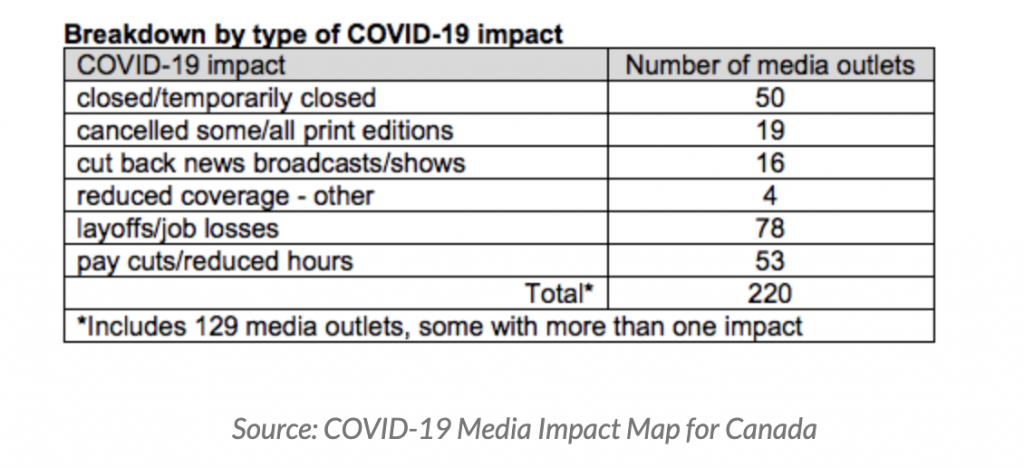
A new impact report on J-Source shows that more than 2,000 media jobs at about 100 Canadian news companies have been lost over a recent six week period. That includes newspapers, television and radio outlets. Fifty media outlets have temporarily or permanently closed, and 19 newspapers have canceled some or all print editions, largely because of advertising hemorrhaging. All this is occurring at a moment in time when the public wants and needs to be more informed than ever by objective journalists; indeed, StatsCan survey data shows that more than half of poll respondents say they are searching and relying on traditional media to get daily pandemic developments. The J-Source data collectors state:
“What we found won’t surprise many who have been following the news. Still, the constellation of cuts is sobering. While these data aren’t absolute – our project will be updated regularly – we do know that at local and hyperlocal levels, the pandemic is accelerating what some are describing as a mass extinction event.”
As Peter Klein, executive director of the Global Health Reporting Centre at the University of B.C. said to me recently, this crisis is like a perfect storm. “We’re in the worst global health crisis to befall us in our lifetime at the same time as the number of journalists is in steep decline.”
 Six years ago, the Canadian Media Guild showed that 10,000 journalism jobs were lost over a five-year period. That was just the beginning of the legacy media bloodbath. Advertisers and readers have been defecting to the internet for years. But J-Source, a collaboration between the Ryerson School of Journalism and the Canadian Association of Journalists, shows the carnage has picked up with hurricane speed because of the pandemic.
Just a few months ago, the big American newspaper chain – McClatchy – filed for bankruptcy. Postmedia – Canada’s largest newspaper chain – announced permanent newspaper closures, layoffs and wage rollbacks, citing the effects like advertising losses due to the pandemic. The wire services – so essential during any crisis – are suffering too. Canadian Press president Malcolm Kirk recently said this in a foreboding message: “Amid the backdrop of a sizable number of layoffs, wage rollbacks and cessation of print editions” the wire service is facing mounting pressure from clients looking for “payment holidays and suspension of billings.” We can assume where this goes.
While the decimation of traditional media outlets has also been driven by factors such as advertising migration to social media and falling levels of print and digital subscribers, the COVID-19 pandemic will undoubtedly put the last nail in the coffin of many media companies.
Even before the pandemic hit, media companies were eliminating health, science, and environment beat reporters as a luxury they couldn’t afford or asking health reporters to carve a wider swath with coverage of overlapping areas like environmental health and climate change. Journalism job losses, together with an all hands on deck approach, means that much of the pandemic coverage is being done by generalists, not health specialists who have relationships with the best experts. Since the pandemic began, political reporters and generalists have been providing much of the coverage. There have been no reports of hiring sprees although companies like CNN, which last year shrunk its health team, have re-upped for pandemic coverage, mostly by offering freelance contracts.
Len Bruzzese, executive director of AHCJ and its Center for Excellence in Health Care Journalism, doesn’t know of an agency tracking the number of journalists covering health around the world but he said it’s clear the overall ranks have suffered. Because of the declining numbers of journalists, especially health beat reporters, the AHCJ has recognized that its professional development courses on topics like interpreting medical evidence and covering public health must be offered to generalists as well. Recognizing that there are too few health beat reporters and more generalists being asked to cover the virus, the AHCJ now has a special membership offer for reporters who don’t usually cover health. The discounted fee gives access to pandemic coverage tip sheets, webinars, and other important resources like experts.
The pandemic has shown us that around the universe, our health and survival are interlocked – “One world, one health.” The outcome of this pandemic is dependent on contextual, investigative reporting by journalists everywhere in the world. The pandemic has shown us that every human on Earth is dependent upon timely and accurate information which is why so many media companies dropped their paywalls to make COVID-19 stories freely accessible.
Like so many who have been tuning into daily news conferences by health ministers and other political leaders, I’ve been consuming copious amounts of news from many sources and feel well informed by coverage of the pandemic at local, provincial, state, national and global levels. But while quick turnaround press conference articles and compelling, empathic stories about how individuals are struggling within communities are necessary and worthwhile, media companies must also commit to deeper stories that will help populations around the world learn about missteps in the management of the crisis. There must be more focus on pandemic planning – or the lack of it – isolating the fault lines in each country around shortages of personal protective equipment.
The pandemic calls for an analytical approach to illuminate the bright and dark parts of ever-evolving government policies and decisions by public health experts. There is an abundance of knowledge and discoveries about COVID-19 published already, yet because of media contraction, a shrinking number of journalists, especially those who know how to interpret the technical information. On a recent day, PubMed had over 20,000 publications on the coronavirus while Google Scholar had over 200,000, double the volume a week earlier. There are now thousands of international clinical trials on such things as novel treatments and vaccine candidates. Reporters who specialize in health know they should always include information about risks and potential harm to patients. They know what robust evidence looks like and the importance of independent verification when research is published.
The work of the best journalists we’ve been reading during the pandemic has reminded us why we need them, more than ever. But if the public shrugs off the plight of media companies, health and science journalists will be placed on the endangered species list.
Leave a comment below or message me here: [email protected]
The post COVID-19 amplifying media closures, layoffs, wage cuts: a “mass extinction” effect appeared first on Medicine Matters.
]]>The post Can dogs sniff out COVID-19? Veterinarian researchers using eight labrador retrievers to find out. appeared first on Medicine Matters.
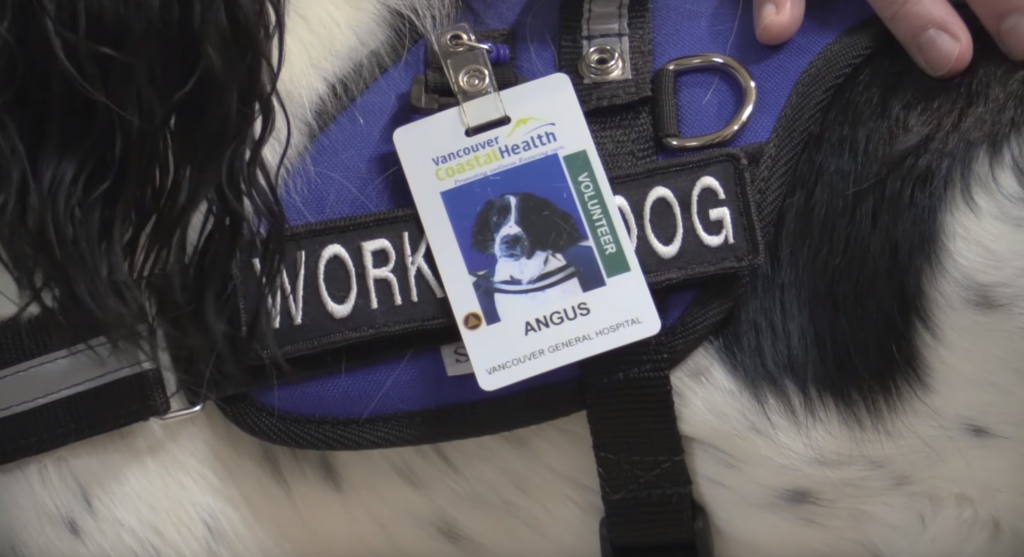
]]>A dog named Angus is a celebrity – and a saviour – in British Columbia hospitals for his ability to sniff out C-difficile in contaminated areas that need more cleaning.
Vancouver General Hospital hired Zurberg and her Springer Spaniel about four years ago and the experiment was such a success that another dog – Dodger – was put into service by Vancouver Coastal Health as well.
The most recent story I wrote is here, when a study about the dogs’ success rates at reducing hospital-acquired infections was published in the Canadian Journal of Infection Control. The dogs have such hyperacute scent detection abilities that they are finding C-diff germs lurking on surfaces, even after they’ve been disinfected (but not well enough, obviously). One of the ickiest revelations was that dogs found C.diff inside toilet paper dispensers. That happens when patients (or their visitors) with contaminated hands reach into the dispenser to pull the tissue down, leaving antibiotic-resistant bacteria on the surface.
This is presumably another way to contract COVID-19 since it has been shown to be in urine and stool. Another reminder to wash your hands!
Teresa Zurberg is the trainer/handler who pioneered the program after she got the superbug herself. With some health issues in her past, she’s been taking a break from hospital work during the COVID-19 crisis, using the time at home to develop a training manual for so many who want to duplicate her success around the world.
Scent detection dogs are becoming more common in the health field and now the University of Pennsylvania School of Veterinarian Medicine, a leader in service dog training, has just announced a pilot training program using eight labrador dogs to see if they can detect COVID-19 in urine and saliva samples. Investigators will test whether dogs can discriminate between COVID-19 positive and negative samples in a lab setting. If successful, the next step would involve testing to see if the dogs can detect COVID-19 in infected people, a goal the researchers want to get to by midsummer.
One can envision dogs being used to detect the virus in all kinds of settings, including airports, to reduce the spread in communities.
I asked Zurberg, a former Canadian Forces medic, and dog trainer/handler, what she thinks about the research. Here’s what she said:
“The COVID detection dog projects are very intriguing. I know Dr. Cynthia Otto from Penn Vet. The projects raise lots of interesting questions and challenges such as what specifically are you going to use as a training aid to train the dogs with, how do we make it safe for the handlers and the dogs, is there a scent signature difference between live virus samples and dead virus samples. (As well), viruses can morph (mutate) quickly so how do you keep the dogs up to date on what the virus is doing in terms of scent signatures, and of course how do you effectively deploy the K9 teams? Plus what liabilities are involved?
“The process is way more intricate than just having an infected person cough into a mask, training a dog to sniff what’s in there and then just holding onto the leash and following a dog around. There is a lot of science and research going into their work before they even start to train a dog. I’m interested to see where this project goes and am following it closely.”
Zurberg’s concerns about how to ensure the dogs don’t get sick during the study are valid although, to date, there are no reports of dogs dying, or even getting very ill from COVID-19. A pet dog in Hong Kong tested positive for COVID-19, as Live Science reported. Another dog, in North Carolina, also tested positive for COVID-19 after likely catching it from its owners, Time reported.
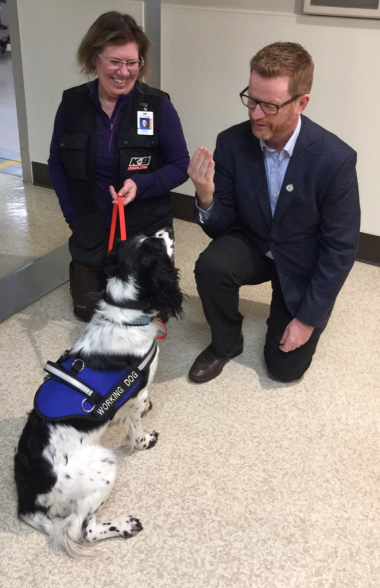
Teresa Zurberg with former BC health minister Terry Lake seen here giving a command to Angus
Here are some links to just a few of the many stories I’ve written about Zurberg and her dog detectives:
The post Can dogs sniff out COVID-19? Veterinarian researchers using eight labrador retrievers to find out. appeared first on Medicine Matters.
]]>The post Filipino health care workers hardest hit by the COVID-19 pandemic? We need to know. appeared first on Medicine Matters.
]]>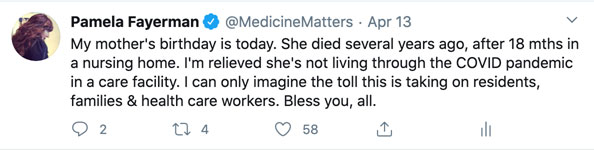
I was so grateful to the care aides and nurses who took care of my father throughout the eight months he was in a facility that, after he died, I wrote a tribute for the many Filipinos who provide care in private homes, residential facilities, and hospitals. Filipino health care workers are known for their work ethic, selflessness, dedication, warmth, compassion, and communal spirit – all qualities which help make them ideal caregivers. Acute and long term care facilities are perennially understaffed. I often ruminate how the health care system would even function without Filipinos.
On the Broadbent Insitute blog, Ethel Tungohan, a Canada Research Chair and assistant professor at York University, says: “… Filipinos constitute 1.2% of the Canadian workforce, (but) they constitute 5.6% of Canada’s total health care aide labour force.” Because of their large numbers in health care, Filipinos must surely be disproportionately affected by the COVID-19 pandemic. Hard data with race analysis is not yet being collected in B.C. but death notices and news stories are clearly showing how hard COVID-19 is hitting Filipinos, not just in health care, but in factories as well.
In B.C., a Filipino advocacy group has called on the provincial government to collect race and ethnicity data to show how the pandemic is affecting those working in health care. RJ Aquino, director of the Tulayan Filipino Diaspora Society, has said that would confirm whether certain groups categorized as essential workers are harder hit; knowing that could lead to better (culturally sensitive) training, policies, and practices.
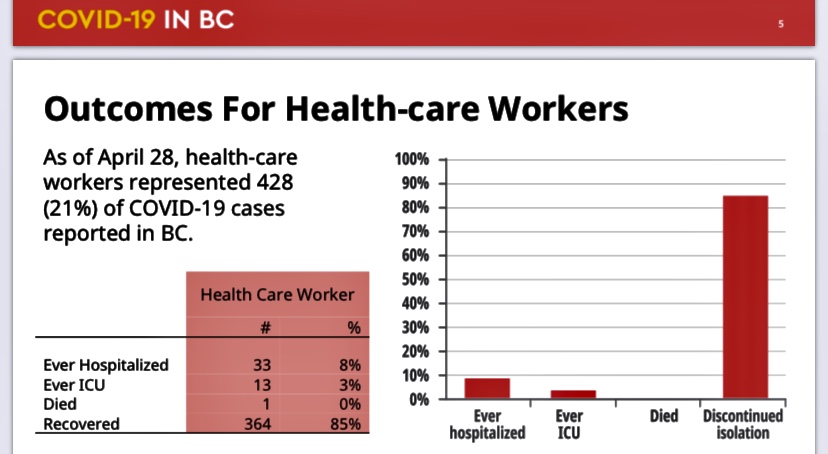
While Filipino health care workers represent a large cohort in health care all over North America, the COVID-19 pandemic is obviously taking an outsize toll on all those working in health care facilities where they face clear and present dangers every time they interact with COVID-19 patients. A report released today in B.C. shows that as of April 28, 428 healthcare workers tested positive for COVID-19. That’s a whopping 21 percent of known cases. So far, 85 percent have recovered but one worker – a Filipino health care worker – died. The B.C. proportion matches the experience in Italy. In Ontario, a recent report says that about 15 percent of COVID cases are among those working in health care. But the number of cases among healthcare workers alone in Ontario – about 2,200 – rivals the total number of all known cases so far in B.C.
Dr. Bonnie Henry, B.C.’s provincial health officer, recognizes the importance of collecting more and better data and she has recently said there are discussions underway about how to start acquiring race and ethnicity data from COVID-19 patients. My opinion is that any such initiative should be retrospective so that the more than 2,200 cases of BC residents who have already tested positive are included in the dataset.
On the health news STAT website, writer Usha Lee McFarling has written a sad piece about the many Filipino nurses who’ve gotten COVID-19, partly because of their close proximity to ill patients, lack of adequate protective gear and long hours they’re working.
Follow me on Twitter: @MedicineMatters
The post Filipino health care workers hardest hit by the COVID-19 pandemic? We need to know. appeared first on Medicine Matters.
]]>